Eighteen months on from its announcement and general availability, it has moved well beyond the roadmap slide stage. Datasphere, Analytics Cloud and SAP’s curated business content now sit together under one roof, delivering a single semantic layer, zero-copy access to Snowflake and Databricks and a foundation trusted enough for Joule and other AI agents to act on.
That is a genuinely significant shift. That said, if you have spent any time around SAP transformation projects, you will know that the interesting part of BDC is not the architecture diagram. It is what your organisation does with it, and whether the underlying reasons your data has been hard to use, are actually being addressed.
The Gap BDC Is Designed To Close
Most SAP customers we speak with are not short of data. They are short of trust in it and short of people outside IT, who can reach it without raising a ticket.
Three patterns show up repeatedly. First, SAP data sits behind the ERP with no analytics layer of its own, so business users depend on IT for every report, every variance, every ad hoc question. Second, SAP and non-SAP systems each hold a partial version of the truth, so finance, supply chain and commercial teams end up reconciling numbers in spreadsheets rather than trusting a shared source. Third, where organisations have tried to solve this by extracting SAP data into a warehouse or data lake, they have often paid twice: once in licensing terms and once in the loss of the business context that made the data meaningful inside SAP to begin with.
BDC is SAP’s answer to all three. A governed semantic layer, an open architecture that connects to the platforms you already run workloads on and a route to keep business context intact rather than flattening it on the way out of the ERP. Think of it as defining “overdue order” once, rather than arguing about it in every dashboard. Once the business agrees the definition, it travels with the data into SAC, Power BI, Databricks or wherever teams choose to work. That means fewer competing versions of the same metric and fewer meetings spent working out whose number is right. On paper it is a sensible design, which is why analysts have been positioning it as one of the more consequential SAP announcements since SAP Cloud ERP (S/4HANA).
Considering SAP Business Data Cloud? Start by understanding what BDC means for your existing data landscape.
BDC As A Core Pillar Of The SAP Autonomous Enterprise
Not only is BDC the solution for the above gaps, it also sits at the very heart of the SAP AI revolution. BDC delivers the data and the context that drives the Business AI Platform, the core of the Knowledge Graph that is the heart of the AI contextualising and reason. With BDC as part of your platform you are ready to embrace the SAP AI revolution. Moving from old-style user interfaces to Joule conversation driven interactions. Transforming your data platform to BDC will deliver opportunities to engage with SAP’s AI vision at speed and scale.
Why Execution Decides How Far BDC Takes You
Here is the honest part. We have watched enough SAP data projects over the years to know that even the best platform rarely changes how an organisation works by itself. BDC is a genuine evolution of Datasphere, adding the governance, multi-model compute and open connectivity that turn a strong data platform into a proper data fabric. Even so, we have also seen organisations invest in that kind of capability and use only a fraction of it, not because the technology fell short but because nobody had settled which data mattered most, who owned it and where the first use case should be.
We saw this play out clearly with a mining client whose reporting had been constrained for years by the performance limits of a legacy data warehouse. Once the landscape and ownership questions were settled, business users were building their own Datasphere models within two months, without waiting on IT to mediate every request.
BDC will not settle those questions for you. It will make the answers easier to act on once you have them, particularly as SAP extends BDC Connect into Snowflake, Databricks, BigQuery and Microsoft Fabric through 2026. Still, the sequencing matters. Organisations that treat BDC as a straight lift and shift of their existing reporting approach will end up with a well governed version of what they had before. Organisations that use the shift as a reason to map their landscape properly, agree a shared definition of the metrics that matter, and prove value with one function before scaling, will see a materially different outcome.
What We Would Actually Prioritise
If you are running SAP without a dedicated analytics layer, three things are worth doing before committing to a BDC roadmap.
First, be honest about your current state. Where does reporting actually happen today: in SAP, in a warehouse, or in someone’s spreadsheet and how much of that is duplicated effort dressed up as due diligence? Second, decide what your target architecture needs to include beyond SAP. Very few organisations run SAP in isolation, so the semantic layer only earns its keep if it can sit across Datasphere, SAC and whichever of Snowflake, Azure, or Databricks your other teams have already invested in. Third, resist the urge to solve everything at once. Pick one use case where inconsistent reporting is costing real time or real money, prove the model works there and use that evidence to build the case for scaling licensing and cost commitments across the wider business.
None of this is complicated in principle. It is, however, easy to skip when a vendor conversation moves quickly and a platform decision starts to feel like the finish line, rather than the start.
A Pragmatic Next Step
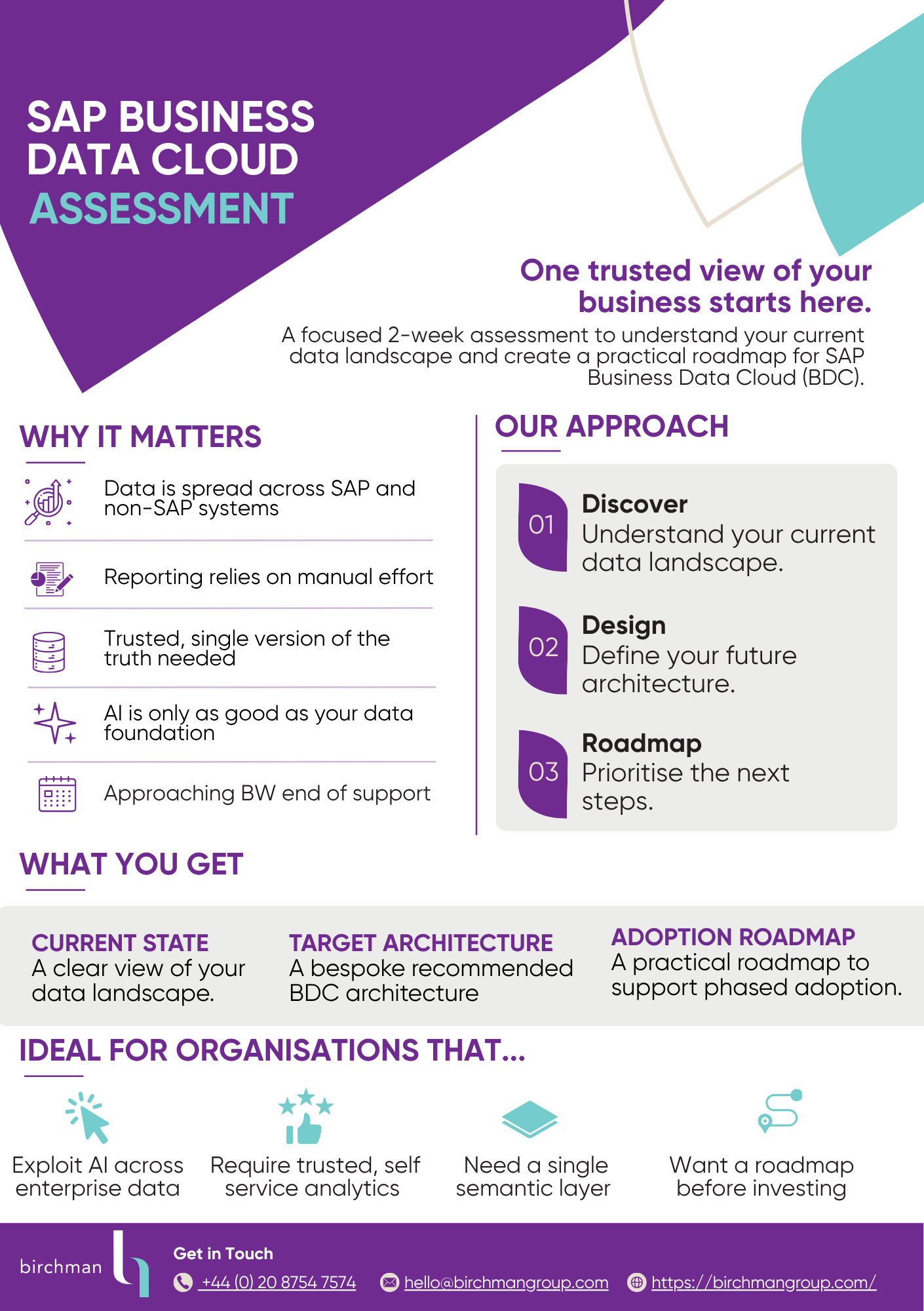
We built the Birchman BDC Assessment for organisations at exactly this point: convinced BDC is the right direction but wanting a clear, evidenced view of what it means for their own landscape before committing budget and timelines. Over two weeks, we map your current data and reporting landscape, design a target state architecture that connects Datasphere, SAC and your wider platforms into one semantic layer and build a phased adoption roadmap with licensing and cost estimates you can take to a business case.
There is no obligation to have us deliver on what follows. The output is yours to keep, present to the board, or hand to another partner entirely: the value sits in the clarity, not in who acts on it. It will not tell you BDC is the answer to everything. It will tell you, plainly, where it earns its place in your architecture and where the real work still needs to happen.