As organisations navigate digital transformation, choosing the right SAP data and analytics architecture has become a strategic priority. With multiple platforms available, understanding the SAP Analytics Cloud vs SAP Datasphere vs SAP BW/4HANA landscape is critical to building a scalable, future ready solution.
This SAP analytics tools comparison breaks down the roles, strengths and ideal use cases of each platform. It helps to align transformation investments with a cloud first analytics strategy while ensuring governance, performance and business value.
Overview of SAP’s Modern Data and Analytics Landscape
As organisations move toward data-driven transformation, SAP offers a powerful ecosystem to manage, connect and analyse enterprise data. Among the most discussed solutions are SAP Analytics Cloud (SAC), SAP Datasphere and SAP BW/4HANA.
While often mentioned together, each plays a very distinct role in SAP’s modern data landscape. Understanding their differences and how they complement one another is essential to designing an effective data strategy.
SAP Analytics Cloud vs Datasphere vs BW/4HANA: Key Capabilities and Differences
#1: SAP Analytics Cloud: Turning Data into Decisions
What It Is:
SAP Analytics Cloud is SAP’s unified solution for business intelligence, planning and predictive analytics. Delivered entirely via the cloud, it empowers business users to visualise data, create forecasts and make confident decisions based on real time insights.
Key capabilities:
- Interactive dashboards and self service reporting
- Financial planning and budgeting
- Predictive analytics powered by machine learning
- Integration with SAP Cloud ERP (S/4HANA) Public, SAP BW/4HANA, SAP Datasphere and non SAP data source
Pros:
✔️ Unified platform for BI, planning and predictive analytics
✔️Cloud based and accessible anywhere
✔️Tight integration with SAP systems
✔️Modern, intuitive user interface for non technical users
✔️Built in AI features like Smart Insights and Smart Predict
Cons:
X Limited large scale data storage (relies on live or imported connections)
X Performance depends on data source and connection method
X Complex enterprise modelling still requires a backend (e.g. SAP BW/4HANA or Datasphere)
Best for: Business analysts, finance teams and decision makers who need agile, real time analytics and planning with minimal IT dependency.
#2: SAP Datasphere: The Modern Data Fabric Layer
What It Is:
SAP Datasphere (formerly SAP Data Warehouse Cloud) is SAP’s cloud based data management and integration platform. It acts as a data fabric, connecting data across SAP and non-SAP systems, both on-premise and in the cloud.
Datasphere doesn’t just store data, it enables you to model, virtualise and govern data from multiple systems while maintaining business context.
Key capabilities:
- Data integration, virtualisation and replication
- Business modelling and semantic layer
- Federated access to SAP and non SAP data
- Tight integration with SAP BW/4HANA, SAP Cloud ERP (S/4HANA) Public and SAP Analytics Cloud
- Built for hybrid and multi-cloud environments
Pros:
✔️ Unified view of enterprise data across multiple sources
✔️ Cloud native scalability and flexibility
✔️ Real time data federation without duplication
✔️ Integrates seamlessly with SAC for analytics
✔️ Ideal for hybrid SAP + non SAP landscapes
Cons:
X Still maturing compared to SAP BW/4HANA, for complex enterprise data models
X Higher cloud costs if not optimised
X Strong governance required to manage decentralised data access
Best for: Organisations pursuing a cloud first analytics strategy, connecting data across multiple systems while retaining agility and control.
#3: SAP BW/4HANA: The Enterprise Data Warehouse Backbone
What It Is:
SAP BW/4HANA is the evolution of SAP’s traditional Business Warehouse and reimagined for the SAP HANA in memory platform. It’s a centralised data warehouse that structures, cleanses and consolidates enterprise data for reporting and analytics.
Key Capabilities:
- Advanced ETL and data modelling
- Data governance and lifecycle management
- Integration with SAP and non SAP sources
- Optimised for high performance on SAP BW/4HANA
- Serves as a data foundation for SAP Analytics Cloud and SAP Datasphere
Pros:
✔️ Proven, mature enterprise data warehousing solution
✔️ Excellent data governance and lineage tracking
✔️ Tight integration with SAP systems
✔️ High performance with SAP HANA’s in memory computing
✔️ Supports hybrid and cloud deployments
Cons:
X Primarily focused on structured, governed data
X On-premise or private cloud, less flexible than SAP Datasphere
X Requires specialised SAP skills to implement and maintain
X Limited self service capability compared to SAP Datasphere or SAP Analytics Cloud
Best for: Large enterprises needing a highly governed, structured and reliable data warehouse as the backbone of their analytics ecosystem, especially when deciding when to use SAP BW/4HANA for complex, regulated environments.
#4: How SAP Analytics Cloud, Datasphere and BW/4HANA Work Together?
While each solution serves a distinct purpose, they are most powerful when used together:
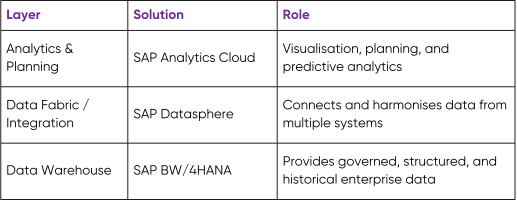
In a modern architecture:
- SAP Analytics Cloud sits on top, providing business friendly analytics and planning capabilities
- SAP Datasphere extends data access to the cloud and non SAP systems
- SAP BW/4HANA serves as the trusted data foundation
Together, they form a layered architecture where BW/4HANA ensures governance, Datasphere enables flexibility and SAC delivers insights, creating a unified and scalable analytics ecosystem.
#5: How to Choose the Right SAP Data Architecture
Your choice depends on where you are in your data journey:
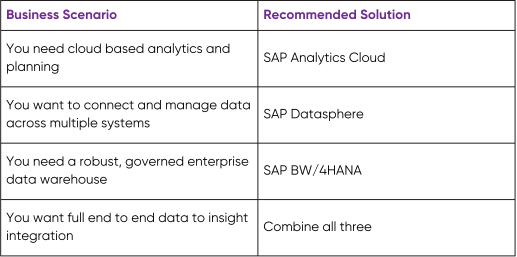
If your priority is business user analytics and planning → Start with SAP Analytics Cloud
If your priority is data integration across hybrid systems → Invest in SAP Datasphere
If your priority is governed, enterprise grade data warehousing → Use SAP BW/4HANA
In reality, most organisations will adopt a combination of all three, guided by a clear SAP analytics tools comparison and aligned to long term business outcomes.
#6: Final Thoughts
SAP’s data and analytics portfolio isn’t about choosing one tool over another, it’s about creating the right combination to meet your organisation’s needs.
- SAP Analytics Cloud delivers actionable insights to business users
- SAP Datasphere introduces flexibility and reach across hybrid data environments
- SAP BW/4HANA provides the stable foundation
Together, they enable a future ready, insight driven enterprise built on a scalable and intelligent data architecture.
Ready to Modernise Your SAP Data Landscape?
At Birchman, we help organisations design and implement end to end SAP data strategies, from SAP BW/4HANAmodernisation to SAP Datasphere integration and SAP Analytics Cloud enablement.
Speak to our experts and discover how to build a future ready analytics landscape.
FAQs
Question #1: What is the difference between SAP Analytics Cloud and SAP Datasphere?
Ans: SAP Analytics Cloud focuses on data visualisation, planning and analytics, while SAP Datasphere is a data integration and modelling platform that connects and prepares data from multiple sources.
Question #2: Do you still need SAP BW/4HANA with SAP Datasphere?
Ans: Yes, in many cases. SAP BW/4HANA provides a governed data foundation, while Datasphere extends access and flexibility, especially in hybrid environments.
Question #3: Which SAP analytics tool should I choose first?
Ans: It depends on your priorities. For business insights, start with SAP Analytics Cloud. For data integration, choose Datasphere. For structured data warehousing, begin with BW/4HANA.
Question #4: Can SAP Analytics Cloud work without BW/4HANA?
Ans: Yes, SAP Analytics Cloud can connect directly to SAP Cloud ERP (S/4HANA) Public, Datasphere, or other data sources, but for complex enterprise modelling, a backend like BW/4HANA or Datasphere is often recommended.