Timelines move. Costs rise. Scope expands. Business teams lose confidence. Technical delivery continues but the original value case becomes less visible. At that point, the most useful thing is not more reporting. It is clarity. An independent assessment should help answer three questions quickly:
- Where does the project really stand?
- What is causing the pressure?
- What needs to change to restore control and value?
For Birchman, that means taking a view across the whole project , not just one workstream. The steps at a glance:
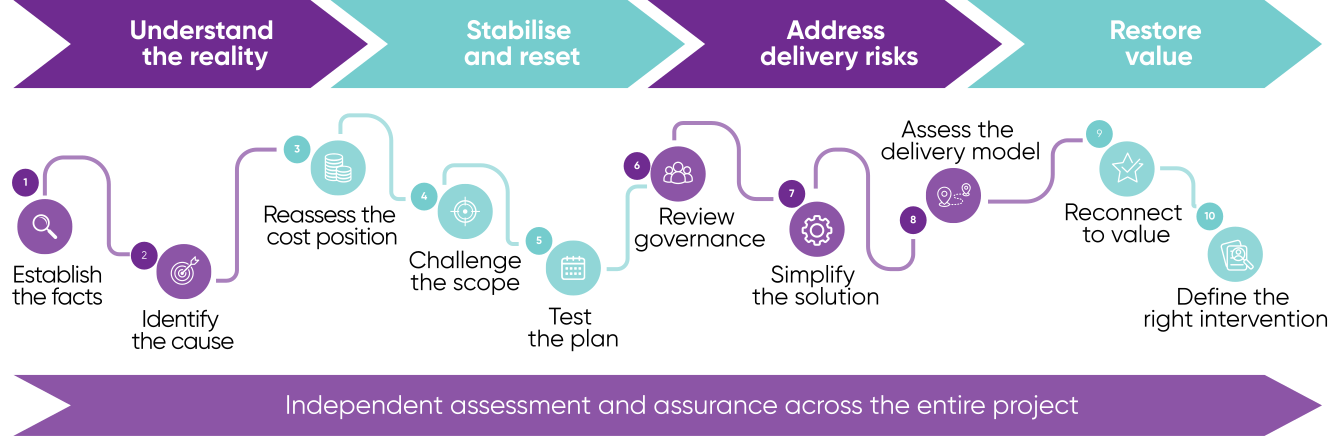
#1 Establish the facts
Before changing anything, establish a clear view of current delivery. That means looking beyond status reports to understand milestones, dependencies, decisions, resource constraints and areas where different teams have different views of progress. The objective is simple: create one version of the truth.
#2 Identify what is actually driving delay
A missed milestone is often a symptom rather than the root cause. Delays may come from unresolved design decisions, weak governance, poor data readiness, unclear ownership or dependencies that were not fully understood at the outset. An independent review should follow the issue back to its source.
#3 Reassess the cost position
An over budget project needs more than a revised forecast. Look at where cost has increased and why. Start by looking at these common causes:
- Additional scope
- Repeated rework
- Longer testing cycles
- Extended use of external resources
- Design complexity
- Unclear commercial ownership
The aim is not just to understand the overspend but to stop the same pattern continuing.
#4 Challenge the scope
Scope often grows gradually. Some additions are essential. Others are inherited, duplicated or no longer worth the effort required to deliver them. An assessment separates:
| Scope type | Question to ask |
|---|---|
| Essential | Does the business need this to operate or meet the project objective? |
| Valuable | Does it justify the additional cost and effort? |
| Optional | Can it move to a later phase? |
| Inherited | Is it still needed at all? |
This can be one of the quickest ways to reduce pressure without undermining the project.
#5 Test whether the plan is still credible
A project plan can remain formally approved long after it has stopped reflecting reality. In a Cloud ERP or S/4HANA programme, delays in one workstream often have a direct impact on others. Review the relationship between:
- Solution design and fit-to-standard decisions
- Configuration and development
- Data migration
- Integrations
- Testing
- Change management and business readiness
- Cutover and deployment
If one area has slipped, assess the knock on effect across the programme. A credible plan should reflect the current status of the project, not the assumptions that were made six months ago.
#6 Look at governance and decision making
Slow decisions create expensive projects. If key issues remain open for weeks or repeatedly appear in steering packs, governance may be adding process without helping delivery. Look at:
- Decision ownership
- Escalation routes
- Time taken to resolve issues
- Quality of project information
- Whether forums are making decisions or simply reviewing them
Good governance should create movement.
#7 Review the solution for unnecessary complexity
Not every project problem is a project management problem. Customisation, integrations and design choices can create cost, rework and testing pressure. The right question is not “can we build it?” It is “does this complexity create enough business value to justify itself?”
#8 Assess the delivery model
The implementation partner is only one part of the picture. Review how responsibilities work across:
- Internal programme leadership
- Business teams
- SAP specialists
- Implementation partners
- Third parties
The aim is to identify gaps, overlap and areas where accountability is unclear. Sometimes the delivery model needs to change. Sometimes the existing model simply needs clearer ownership.
#9 Reconnect the project to business value
A project can be technically deliverable and still offer poor value. If cost, scope or timing has changed, revisit the original business case and ask:
- Are the expected benefits still realistic?
- Is the remaining investment justified?
- Which outcomes matter most now?
- Are programme decisions supporting those outcomes?
This is where SAP business value realisation becomes part of project control rather than something discussed after go-live.
#10 Define the smallest effective intervention
The answer is not always a major reset. Sometimes the project may just need:
- A revised plan
- Clearer governance
- Reduced scope
- Stronger ownership
- Targeted technical intervention
- A different commercial approach
- Additional capability in a specific area
The point is to intervene proportionately. A good independent assessment should make it clear what needs to change, what can stay as it is and what leadership needs to decide next.
What good independent assessment should leave you with
At the end of the exercise, leadership should have a clear view of:
| Question | Outcome |
|---|---|
| Where are we now? | An evidence based project position |
| Why are we under pressure? | Root causes, not symptoms |
| What is creating cost? | Clear cost drivers |
| What is creating risk? | Prioritised project risks |
| What needs to change? | Practical actions and ownership |
| What should stay? | Protection for areas that are working |
| Is the plan credible? | A realistic delivery route |
| Is the project still worth the investment? | A clear view of remaining value |
Our Role
Our role is not to arrive with a predetermined answer. It is to provide an independent view, identify the issues that matter and help leadership make the next set of effective decisions. That means looking at SAP delivery, governance, commercial arrangements, business readiness and value together.
Delayed, over budget or low value projects rarely need more noise. They need a clearer view of what is happening and a strategic route forward.